Orthographic Reference-Plane Character Modeling, <=10k Topology & Finger-Rig Stress Testing in Unity 6
Build game-ready <=10,000-triangle rigged characters by aligning front and side orthographic reference planes at shared landmarks (soles, eyes, shoulders), authoring clean face/joint edge loops with full 30-bone finger rigs, and stress-testing closed fists, bent elbows, and raised shoulders before Unity 6 URP import.
- character
- modeling
- orthographic
- reference-planes
- rigging
- fingers
- topology
- deformation
- silhouette
- humanoid
- animation
No demo.
When to Use (and When Not To)
Use this workflow whenever a game needs a hero character, companion, or stylized fighter whose silhouette, facial proportions, and hand poses must faithfully match concept artwork while staying strictly within real-time triangle and bone budgets:
- Perpendicular orthographic reference planes: Placing Front (
Y = 0) and Side (X = 0) concept sheets intersecting through the character's center lets you match exact proportions and landmark heights (soles, knees, pelvis, shoulders, chin, eyes) instead of eyeballing from a single 3/4 view. - Strict
<= 10,000-triangle budget: Covers the complete character including hair, garments, and accessories so characters run smoothly on desktop, mobile, and browser targets with zero heavy decimation artifacts. - Articulated hand & finger rig (up to 78 bones, 30 in the fingers): Three phalanges per finger plus opposable thumbs enable expressive fighting stances, weapon grips, and closed fists without fused mitten hands.
- Automated extreme-pose deformation verification: Testing closed fists, bent elbows, and raised shoulders catches shoulder collapse, palm clipping, and sleeve pinching before animation authoring begins.
Skip full 30-bone finger rigs for tiny background crowd NPCs seen only from 20+ m away — use a 25-bone mitten rig there to save skinning cost.
Repeatable Orthographic Reference-to-Unity Pipeline
- Generate Aligned Front & Side Reference Sheets: Create a clean orthographic Front + Side character turnaround (
make_concept_art) on a neutral background with matching pose (A-pose, arms clear of torso, fingers relaxed and separated). - Build Intersecting Orthographic Reference Planes (
ortho-setup): Run the studio'sortho-setupstage (--front front.png --side side.png --height 1.75) to construct perpendicular Front (Y = 0) and Side (X = 0) image planes intersecting at the origin, scaled to exact real-world height with soles resting strictly on the ground plane. - Model, Clean Topology & UV-Unwrap (
<= 10,000triangles):
- Match Front and Side silhouettes along the intersecting reference planes, checking continuously from a three-quarter perspective angle (especially face volume, hair silhouette, and hand/thumb thickness).
- Keep concentric edge loops around eyes, mouth, and brow; place 3-loop deformation fans across shoulders, elbows, knees, wrists, and finger knuckles.
- UV-unwrap cleanly with consistent texel density (highest on face/hands) so painted colors wrap around the form without stretching.
- Rig, Skin & Run Automated Ortho + Stress-Pose Verification (
ortho-verify):
- Rig the full skeleton (spine, neck, head, clavicles, arms, legs, and all 30 finger phalanx bones).
- Run
ortho-verify(--max-tris 10000 --height 1.75 --size 512) to verify real-world height,<= 10,000triangle budget, bone & finger coverage, true orthographic Front/Side comparison views, lit 3/4 render (ortho_sheet.png), and extreme joint deformation poses (closed fist, bent elbows, raised shoulders) written toortho_report.json.
- Import to Unity 6 URP & Run Live Joint-Stress Harness: Configure Humanoid/Generic import, attach the stress-pose test harness below, and assert triangle budget, exact real-world height (
1.75 mwith soles atY = 0), and>= 30articulated finger bones in EditMode tests.
Landmark Alignment & Joint Stress Budget
| Check | Target | Failure Sign | |---|---|---| | Real-world height | Exact target (e.g. 1.75 m, soles at Y = 0) | Floating boots or wrong scale relative to doors/props | | Shared landmarks | Soles, knees, pelvis, shoulders, eyes match across Front & Side planes | Elongated neck or shifted hip pivot between views | | Total triangle count | <= 10,000 triangles (hair + clothes + accessories included) | Unbudgeted hair strands or dense shoe soles blowing skinning cost | | Finger rig hierarchy | 30 finger bones (5 digits × 3 phalanges × 2 hands) | Fused mitten hands or missing thumb opposition | | Closed fist test | Proximal/middle/distal phalanges curled ~75–85°, thumb opposed | Fingertips stabbing through palm mesh | | Bent elbow test | Forearm flexed ~125° | Candy-wrapper twist or bicep/forearm self-clipping | | Raised shoulder test | Clavicle +25°, upper arm elevated ~145° | Collapsed deltoid crease or armpit clipping into ribcage |
Engine Implementation
1. Articulated <=10k Character Rig, Intersecting Ortho Planes & Deformation Stress Harness (Assets/Game/Runtime/Animation/OrthoRefCharacterRig.cs)
using System.Collections.Generic;
using UnityEngine;

namespace Game.Animation
{
    public enum CharacterStressPose
    {
        NeutralAPose,
        ClosedFist,
        BentElbows,
        RaisedShoulders,
        FightingStance
    }

    /// <summary>
    /// Procedural <=10,000-triangle articulated humanoid rig with 30 finger phalanx joints,
    /// intersecting Front/Side orthographic reference planes with landmark guides, and an
    /// interactive deformation stress-test harness (closed fist, bent elbows, raised shoulders).
    /// </summary>
    public sealed class OrthoRefCharacterRig : MonoBehaviour
    {
        public const float TargetHeight = 1.75f;
        public const int MaxTriangleBudget = 10000;

        public CharacterStressPose activePose = CharacterStressPose.FightingStance;
        public bool autoCyclePoses = true;
        public float cycleIntervalSeconds = 2.6f;

        public Transform hips;
        public Transform chest;
        public Transform head;
        public Transform leftClavicle, rightClavicle;
        public Transform leftUpperArm, rightUpperArm;
        public Transform leftForearm, rightForearm;
        public Transform leftHand, rightHand;
        public Transform leftThigh, rightThigh;
        public Transform leftShin, rightShin;
        public readonly List<Transform> fingerBones = new List<Transform>(30);
        public GameObject orthoReferenceRoot;

        private float _timer;
        private int _cachedTriangles;

        public int TotalTriangles => _cachedTriangles > 0 ? _cachedTriangles : CountHierarchyTriangles(transform);
        public int FingerBoneCount => fingerBones.Count;

        public static int CountHierarchyTriangles(Transform root)
        {
            int total = 0;
            foreach (var mf in root.GetComponentsInChildren<MeshFilter>(true))
            {
                if (mf.sharedMesh == null) continue;
                if (mf.gameObject.name.StartsWith("OrthoPlane")) continue;
                total += mf.sharedMesh.triangles.Length / 3;
            }
            return total;
        }

        public void BuildRig(Material bodyMat, Material accentMat, Material jointMat, Material frontPlaneMat, Material sidePlaneMat)
        {
            fingerBones.Clear();

            // Root pelvis & torso aligned to 1.75 m human proportions (soles strictly at Y = 0)
            hips = CreateJoint("Hips", transform, new Vector3(0f, 0.94f, 0f));
            AddPart(hips, "PelvisMesh", PrimitiveType.Cube, new Vector3(0f, 0.02f, 0f), new Vector3(0.30f, 0.16f, 0.20f), accentMat);

            var spine = CreateJoint("Spine", hips, new Vector3(0f, 0.12f, 0f));
            AddPart(spine, "AbdomenMesh", PrimitiveType.Cylinder, new Vector3(0f, 0.10f, 0f), new Vector3(0.24f, 0.12f, 0.18f), bodyMat);

            chest = CreateJoint("Chest", spine, new Vector3(0f, 0.22f, 0f));
            AddPart(chest, "TorsoMesh", PrimitiveType.Cube, new Vector3(0f, 0.11f, 0f), new Vector3(0.34f, 0.24f, 0.22f), bodyMat);

            var neck = CreateJoint("Neck", chest, new Vector3(0f, 0.25f, 0f));
            AddPart(neck, "NeckMesh", PrimitiveType.Cylinder, new Vector3(0f, 0.045f, 0f), new Vector3(0.10f, 0.055f, 0.10f), accentMat);

            head = CreateJoint("Head", neck, new Vector3(0f, 0.09f, 0f));
            AddPart(head, "CraniumMesh", PrimitiveType.Sphere, new Vector3(0f, 0.105f, 0f), new Vector3(0.19f, 0.22f, 0.21f), accentMat);
            AddPart(head, "VisorEyes", PrimitiveType.Cube, new Vector3(0f, 0.11f, 0.095f), new Vector3(0.12f, 0.032f, 0.04f), jointMat);

            // Legs pinned so boot soles rest precisely at Y = 0.00 m
            BuildLeg(-1f, hips, bodyMat, accentMat, jointMat, out leftThigh, out leftShin);
            BuildLeg( 1f, hips, bodyMat, accentMat, jointMat, out rightThigh, out rightShin);

            // Arms + 30 articulated finger bones (5 digits x 3 phalanges x 2 hands)
            BuildArm(-1f, chest, bodyMat, accentMat, jointMat, out leftClavicle, out leftUpperArm, out leftForearm, out leftHand);
            BuildArm( 1f, chest, bodyMat, accentMat, jointMat, out rightClavicle, out rightUpperArm, out rightForearm, out rightHand);

            // Intersecting perpendicular Front (Y=0 in Z-normal) & Side (X=0) orthographic reference planes
            orthoReferenceRoot = new GameObject("OrthoPlanes_LandmarkGuides");
            orthoReferenceRoot.transform.SetParent(transform, false);
            BuildOrthoPlane("OrthoPlane_Front", orthoReferenceRoot.transform, new Vector3(0f, TargetHeight * 0.5f, 0f), Quaternion.identity, new Vector3(1.55f, TargetHeight, 1f), frontPlaneMat);
            BuildOrthoPlane("OrthoPlane_Side",  orthoReferenceRoot.transform, new Vector3(0f, TargetHeight * 0.5f, 0f), Quaternion.Euler(0f, 90f, 0f), new Vector3(1.55f, TargetHeight, 1f), sidePlaneMat);

            _cachedTriangles = CountHierarchyTriangles(transform);
            ApplyPose(activePose);
        }

        public void ApplyPose(CharacterStressPose pose)
        {
            activePose = pose;
            if (hips == null || leftUpperArm == null || rightUpperArm == null) return;

            // Reset to clean A-pose baseline
            hips.localPosition = new Vector3(0f, 0.94f, 0f);
            hips.localRotation = Quaternion.identity;
            chest.localRotation = Quaternion.identity;
            head.localRotation = Quaternion.identity;
            leftClavicle.localRotation = Quaternion.identity;
            rightClavicle.localRotation = Quaternion.identity;
            leftUpperArm.localRotation = Quaternion.Euler(0f, 0f, 40f);
            rightUpperArm.localRotation = Quaternion.Euler(0f, 0f, -40f);
            leftForearm.localRotation = Quaternion.identity;
            rightForearm.localRotation = Quaternion.identity;
            leftThigh.localRotation = Quaternion.identity;
            rightThigh.localRotation = Quaternion.identity;
            leftShin.localRotation = Quaternion.identity;
            rightShin.localRotation = Quaternion.identity;
            SetFingerCurl(0.10f);

            switch (pose)
            {
                case CharacterStressPose.ClosedFist:
                    leftUpperArm.localRotation = Quaternion.Euler(-35f, 12f, 22f);
                    rightUpperArm.localRotation = Quaternion.Euler(-35f, -12f, -22f);
                    leftForearm.localRotation = Quaternion.Euler(-55f, 0f, 0f);
                    rightForearm.localRotation = Quaternion.Euler(-55f, 0f, 0f);
                    SetFingerCurl(1.0f);
                    break;

                case CharacterStressPose.BentElbows:
                    leftUpperArm.localRotation = Quaternion.Euler(-15f, 0f, 12f);
                    rightUpperArm.localRotation = Quaternion.Euler(-15f, 0f, -12f);
                    leftForearm.localRotation = Quaternion.Euler(-122f, 0f, 0f);
                    rightForearm.localRotation = Quaternion.Euler(-122f, 0f, 0f);
                    SetFingerCurl(0.65f);
                    break;

                case CharacterStressPose.RaisedShoulders:
                    leftClavicle.localRotation = Quaternion.Euler(0f, 0f, -24f);
                    rightClavicle.localRotation = Quaternion.Euler(0f, 0f, 24f);
                    leftUpperArm.localRotation = Quaternion.Euler(0f, 0f, -125f);
                    rightUpperArm.localRotation = Quaternion.Euler(0f, 0f, 125f);
                    leftForearm.localRotation = Quaternion.Euler(-22f, 0f, 0f);
                    rightForearm.localRotation = Quaternion.Euler(-22f, 0f, 0f);
                    SetFingerCurl(0.25f);
                    break;

                case CharacterStressPose.FightingStance:
                    hips.localPosition = new Vector3(0f, 0.89f, 0f);
                    hips.localRotation = Quaternion.Euler(4f, -22f, 0f);
                    chest.localRotation = Quaternion.Euler(6f, 14f, 0f);
                    head.localRotation = Quaternion.Euler(-4f, 10f, 0f);
                    leftUpperArm.localRotation = Quaternion.Euler(-58f, 18f, 18f);
                    leftForearm.localRotation = Quaternion.Euler(-78f, 0f, 0f);
                    rightUpperArm.localRotation = Quaternion.Euler(-48f, -14f, -24f);
                    rightForearm.localRotation = Quaternion.Euler(-96f, 0f, 0f);
                    leftThigh.localRotation = Quaternion.Euler(-18f, 0f, 4f);
                    leftShin.localRotation = Quaternion.Euler(24f, 0f, 0f);
                    rightThigh.localRotation = Quaternion.Euler(14f, 0f, -4f);
                    rightShin.localRotation = Quaternion.Euler(18f, 0f, 0f);
                    SetFingerCurl(0.95f);
                    break;
            }
        }

        private void SetFingerCurl(float curl01)
        {
            float c = Mathf.Clamp01(curl01);
            for (int i = 0; i < fingerBones.Count; i++)
            {
                var bone = fingerBones[i];
                if (bone == null) continue;
                bool isThumb = bone.name.Contains("Thumb");
                float sign = bone.name.StartsWith("L_") ? 1f : -1f;
                if (isThumb)
                    bone.localRotation = Quaternion.Euler(c * 24f, sign * c * 32f, -sign * c * 28f);
                else
                    bone.localRotation = Quaternion.Euler(0f, 0f, -sign * c * 74f);
            }
        }

        private void Update()
        {
            if (!autoCyclePoses) return;
            _timer += Time.deltaTime;
            if (_timer >= cycleIntervalSeconds)
            {
                _timer = 0f;
                int next = ((int)activePose + 1) % 5;
                ApplyPose((CharacterStressPose)next);
            }
        }

        private void BuildLeg(float side, Transform parent, Material bodyMat, Material accentMat, Material jointMat,
            out Transform thigh, out Transform shin)
        {
            string pfx = side < 0f ? "L_" : "R_";
            thigh = CreateJoint(pfx + "Thigh", parent, new Vector3(side * 0.11f, -0.04f, 0f));
            AddPart(thigh, pfx + "ThighMesh", PrimitiveType.Cylinder, new Vector3(0f, -0.22f, 0f), new Vector3(0.13f, 0.22f, 0.13f), bodyMat);

            shin = CreateJoint(pfx + "Shin", thigh, new Vector3(0f, -0.44f, 0f));
            AddPart(shin, pfx + "KneeJoint", PrimitiveType.Sphere, Vector3.zero, Vector3.one * 0.11f, jointMat);
            AddPart(shin, pfx + "ShinMesh", PrimitiveType.Cylinder, new Vector3(0f, -0.20f, 0f), new Vector3(0.105f, 0.20f, 0.105f), bodyMat);

            var foot = CreateJoint(pfx + "Foot", shin, new Vector3(0f, -0.40f, 0f));
            // Boot bottom sits strictly at local y = -0.06 => world Y = 0.94 - 0.04 - 0.44 - 0.40 - 0.06 = 0.00 m
            AddPart(foot, pfx + "BootMesh", PrimitiveType.Cube, new Vector3(0f, -0.03f, 0.055f), new Vector3(0.10f, 0.06f, 0.22f), accentMat);
        }

        private void BuildArm(float side, Transform parent, Material bodyMat, Material accentMat, Material jointMat,
            out Transform clavicle, out Transform upperArm, out Transform forearm, out Transform hand)
        {
            string pfx = side < 0f ? "L_" : "R_";
            clavicle = CreateJoint(pfx + "Clavicle", parent, new Vector3(side * 0.09f, 0.21f, 0f));
            upperArm = CreateJoint(pfx + "UpperArm", clavicle, new Vector3(side * 0.11f, -0.02f, 0f));
            AddPart(upperArm, pfx + "ShoulderBall", PrimitiveType.Sphere, Vector3.zero, Vector3.one * 0.115f, jointMat);
            AddPart(upperArm, pfx + "UpperArmMesh", PrimitiveType.Cylinder, new Vector3(0f, -0.145f, 0f), new Vector3(0.095f, 0.145f, 0.095f), bodyMat);

            forearm = CreateJoint(pfx + "Forearm", upperArm, new Vector3(0f, -0.29f, 0f));
            AddPart(forearm, pfx + "ElbowBall", PrimitiveType.Sphere, Vector3.zero, Vector3.one * 0.088f, jointMat);
            AddPart(forearm, pfx + "ForearmMesh", PrimitiveType.Cylinder, new Vector3(0f, -0.135f, 0f), new Vector3(0.08f, 0.135f, 0.08f), accentMat);

            hand = CreateJoint(pfx + "Hand", forearm, new Vector3(0f, -0.27f, 0f));
            AddPart(hand, pfx + "PalmMesh", PrimitiveType.Cube, new Vector3(0f, -0.045f, 0f), new Vector3(0.032f, 0.085f, 0.082f), accentMat);

            string[] digits = { "Thumb", "Index", "Middle", "Ring", "Pinky" };
            float[] zOffsets = { 0.042f, 0.030f, 0.010f, -0.012f, -0.032f };
            float[] lengths  = { 0.024f, 0.028f, 0.031f, 0.028f, 0.022f };

            for (int d = 0; d < digits.Length; d++)
            {
                Transform prev = hand;
                Vector3 basePos = d == 0
                    ? new Vector3(0f, -0.035f, zOffsets[d])
                    : new Vector3(0f, -0.088f, zOffsets[d]);
                for (int ph = 1; ph <= 3; ph++)
                {
                    var bone = CreateJoint($"{pfx}{digits[d]}_{ph}", prev, ph == 1 ? basePos : new Vector3(0f, -lengths[d], 0f));
                    float segLen = lengths[d] * (ph == 3 ? 0.78f : 0.95f);
                    AddPart(bone, $"{pfx}{digits[d]}_{ph}_Mesh", PrimitiveType.Cube, new Vector3(0f, -segLen * 0.5f, 0f), new Vector3(0.015f, segLen, 0.015f), jointMat);
                    fingerBones.Add(bone);
                    prev = bone;
                }
            }
        }

        private static Transform CreateJoint(string name, Transform parent, Vector3 localPos)
        {
            var go = new GameObject(name);
            go.transform.SetParent(parent, false);
            go.transform.localPosition = localPos;
            return go.transform;
        }

        private static void AddPart(Transform parent, string name, PrimitiveType type, Vector3 localPos, Vector3 localScale, Material mat)
        {
            var go = GameObject.CreatePrimitive(type);
            go.name = name;
            Object.DestroyImmediate(go.GetComponent<Collider>());
            go.transform.SetParent(parent, false);
            go.transform.localPosition = localPos;
            go.transform.localScale = localScale;
            go.GetComponent<MeshRenderer>().sharedMaterial = mat;
        }

        private static void BuildOrthoPlane(string name, Transform parent, Vector3 pos, Quaternion rot, Vector3 scale, Material mat)
        {
            var go = GameObject.CreatePrimitive(PrimitiveType.Quad);
            go.name = name;
            Object.DestroyImmediate(go.GetComponent<Collider>());
            go.transform.SetParent(parent, false);
            go.transform.localPosition = pos;
            go.transform.localRotation = rot;
            go.transform.localScale = scale;
            var mr = go.GetComponent<MeshRenderer>();
            mr.sharedMaterial = mat;
            mr.shadowCastingMode = UnityEngine.Rendering.ShadowCastingMode.Off;
        }
    }
}
Performance & Platform Traps
- Align Landmarks Before Blocking Volume: If the Front reference's eyes or knees sit 3 cm higher than the Side reference's, modeling across both planes produces a skewed skull and crooked knee joints. Pin soles to
Z = 0and match eye/pelvis/shoulder guide lines first. - Check Three-Quarter Views Continuously: Tracing Front and Side silhouettes alone produces a diamond-shaped face and slab-like hands. Orbit to 3/4 view after every major loop cut.
- Never Skip Joint Stress Tests: A character that looks spotless in A-pose frequently collapses at the deltoid when arms raise 145° or clips fingertips through the palm in a closed fist. Automate all three stress poses before UV baking.
- Watch Accessory & Hair Triangle Creep: Strands of hair, belt buckles, and shoelaces silently double polygon counts. Enforce the
<= 10,000-triangle ceiling across the *combined* exported hierarchy.
Verification Checklist
- Confirm combined character triangle count (body + hair + accessories, excluding reference planes) is
<= 10,000triangles. - Verify real-world character height matches target (
1.75 m ± 0.05 m) with boot soles resting cleanly onY = 0. - Assert all 30 finger phalanx joints (
5 digits × 3 phalanges × 2 hands) exist in the rig hierarchy and respond to flex drivers. - Inspect Orthographic Front, Orthographic Side, and Lit 3/4 captures alongside Closed Fist, Bent Elbows, and Raised Shoulders poses for silhouette match and clean deformation.
Official references
- 3D Armature & Weight Painting Standards
- Unity 6 Humanoid Avatar & SkinnedMeshRenderer Reference
- Game Character Topology & Joint Deformation Standards
More Unity 6 games
Games made with GameCrew on the same engine. No game has been built with this guide yet: these show what Unity 6 games here look like.
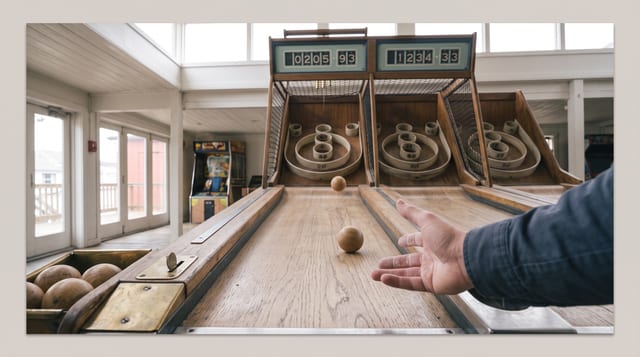
Saltwood Alley
Step up to the sunlit timber lanes of an old seaside arcade, feel the weight of turned maple in your palm, and bend real wrist-spin shots into tight vintage scoring cups.

Bottomless
Drop into a waist-deep powder bowl on the morning after the storm and feel every turn throw a wall of snow into the sun.
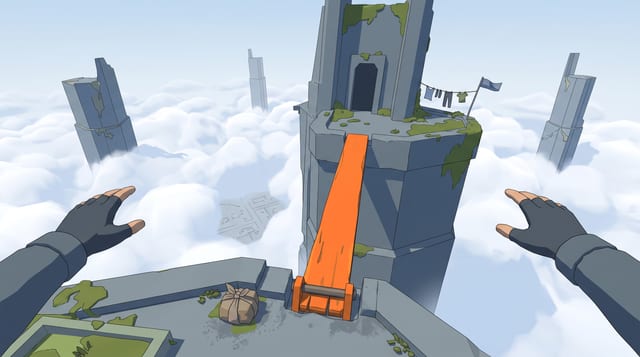
Thin Air Errands
Three hundred metres up, with a storm on the way, you carry your own plank between rooftops, lay it across the gap, and walk it with your arms out.
More Unity 6 techniques
CharacterController Slope Projection & Floor Snap in Unity 6 →
Deterministic Unity 6 CharacterController locomotion with SphereCast ground projection, ramp stickiness, steep-slope slide, and coyote jumps.
Active Ragdoll Falls & Bails on a Procedurally Posed Humanoid in Unity 6 →
Turn an animated or procedurally posed rigged humanoid into a muscled ragdoll at runtime (no Ragdoll Wizard) for falls and bails, with hinges that hold, no pop or one-step lag at the switch, PD muscle tone that decays, protective reflexes, and a clean hand-back to the animated rig.
Cel-Shading, Shadow Ramps & Width-Compensated Outlines in Unity 6 URP →
Two-pass URP stylized cel shader combining main-light shadow-attenuated diffuse ramps, crisp specular/rim accents, and clip-space distance-compensated inverted-hull outlines.
Parametric Mechanical Rigs: Normalized 0–1 Drivers, Clamped Limits & Swept Clearance Verification in Unity 6 →
Turn concept turnarounds and mechanism close-ups into articulated game-ready mechanical rigs driven by hard-clamped 0–1 parameters (hinges, telescoping pistons, turrets, jaws) verified across full motion sweeps for zero triangle overlaps and guaranteed millimetre clearance before Unity 6 URP runtime playback.
Read via free MCP — or sign in to add techniques & beta test
Use /mcp/library free with no login to query guides, or connect via OAuth at /mcp to contribute technique guides and beta test cloud builds.