Hex Forcefields, Emissive Noise Dissolve & Stylized Slash VFX in Unity 6 URP
Textureless URP 17 HLSL combat and sci-fi VFX trio: depth-intersecting hexagonal forcefield with impact ripples, shadow-aware HDR emissive dissolve, stylized melee slash arcs, and a zero-allocation MaterialPropertyBlock driver.
- forcefield
- shield
- hex
- dissolve
- slash
- vfx
- impact
- ripple
- shader
- urp
- bloom
No demo.
When to Use & Field Best Practices
Combat, sci-fi defense, and boss encounters feel flat when enemies vanish instantaneously or shields look like plain translucent spheres. Three lightweight, zero-texture URP 17 HLSL shaders give crisp visual feedback that triggers URP Bloom naturally and runs smoothly on WebGL 2 and Quest VR:
- Procedural Hex Forcefield (
Custom/HexForcefield): Computes a crisp procedural hexagon distance field in object/UV space (no tiling PNG needed), adds Fresnel silhouette energy +_CameraDepthTexturefloor/wall intersection glow, and animates a world-space expanding hit ripple (_HitPos,_HitTime) whenever a projectile lands. - Shadow-Aware Emissive Dissolve (
Custom/EmissiveNoiseDissolve): Combines procedural 3D value noise with an optional world-height wipe and a bright HDR burn rim (_EdgeColorat intensity2.5–4.0so URP Bloom picks it up). Includes a matchingShadowCasterpass with the exact sameclip(...)so dissolving enemies stop casting solid boxy shadows mid-disintegration. - UV-Scrolled Stylized Slash Arc (
Custom/StylizedSlashArc): Drives a curved ribbon/crescent mesh with a single0 -> 1progress parameter (_SlashProgress) so sword swipes and boss telegraphs sweep smoothly across an arc with jagged eroded tails and a hot leading edge. - Zero-Allocation
MaterialPropertyBlockDriver: Never accessrenderer.materialper hit (which instantiates leaked material copies); push_Dissolve,_HitPos, and_SlashProgressthrough a sharedMaterialPropertyBlock.
Mathematical & Algorithmic Core
- Hexagonal Grid Edge Distance: Fold planar coordinates onto two offset rectangular lattices
a = mod(p, r) - tfrac12r,b = mod(p - tfrac12r, r) - tfrac12rwherer = (1, √3), choose the closer centerg, and evaluate edge distanced_edge = 0.5 - max(g·(0.5, tfrac√32),\, |g_x|). - Expanding Impact Ring: For hit center
hand elapsed age τ: $r(p, τ) = exp\!(-(frac|p - h| - vτw)^2)· (1 - τ)^2$
Engine Implementation
1. Procedural Hex Forcefield Shader (Assets/Game/Resources/Shaders/HexForcefield.shader)
Shader "Custom/HexForcefield"
{
    Properties
    {
        [HDR] _ShieldColor ("Shield Color (HDR)", Color) = (0.18, 0.85, 1.5, 0.55)
        [HDR] _HitColor ("Impact Ripple Color (HDR)", Color) = (1.8, 0.95, 0.35, 1.0)
        _HexParams ("HexScale, LineWidth, FresnelPow, IntersectDepth", Vector) = (10.0, 0.06, 2.8, 0.55)
        _HitPos ("Hit World Pos (xyz) & Age 0..1 (w)", Vector) = (0.0, 0.0, 0.0, 1.0)
    }
    SubShader
    {
        Tags { "RenderPipeline" = "UniversalPipeline" "Queue" = "Transparent" "RenderType" = "Transparent" }
        Pass
        {
            Name "HexForcefieldForward"
            Tags { "LightMode" = "UniversalForward" }
            Blend SrcAlpha One
            ZWrite Off
            Cull Off

            HLSLPROGRAM
            #pragma vertex vert
            #pragma fragment frag
            #pragma multi_compile_instancing

            #include "Packages/com.unity.render-pipelines.universal/ShaderLibrary/Core.hlsl"
            #include "Packages/com.unity.render-pipelines.universal/ShaderLibrary/DeclareDepthTexture.hlsl"

            CBUFFER_START(UnityPerMaterial)
                half4 _ShieldColor;
                half4 _HitColor;
                float4 _HexParams;
                float4 _HitPos;
            CBUFFER_END

            struct Attributes
            {
                float4 positionOS : POSITION;
                float3 normalOS : NORMAL;
                float2 uv : TEXCOORD0;
                UNITY_VERTEX_INPUT_INSTANCE_ID
            };

            struct Varyings
            {
                float4 positionCS : SV_POSITION;
                float3 positionWS : TEXCOORD0;
                float3 normalWS : TEXCOORD1;
                float2 uv : TEXCOORD2;
                float4 screenPos : TEXCOORD3;
                UNITY_VERTEX_INPUT_INSTANCE_ID
            };

            float HexEdgeDist(float2 p)
            {
                const float2 r = float2(1.0, 1.7320508);
                const float2 h = r * 0.5;
                float2 a = p - r * floor(p / r) - h;
                float2 b = (p - h) - r * floor((p - h) / r) - h;
                float2 g = dot(a, a) < dot(b, b) ? a : b;
                float2 ag = abs(g);
                float d = max(dot(ag, normalize(float2(1.0, 1.7320508))), ag.x);
                return 0.5 - d;
            }

            Varyings vert(Attributes input)
            {
                Varyings o;
                UNITY_SETUP_INSTANCE_ID(input);
                UNITY_TRANSFER_INSTANCE_ID(input, o);
                VertexPositionInputs pos = GetVertexPositionInputs(input.positionOS.xyz);
                o.positionCS = pos.positionCS;
                o.positionWS = pos.positionWS;
                o.normalWS = TransformObjectToWorldNormal(input.normalOS);
                o.uv = input.uv;
                o.screenPos = ComputeScreenPos(pos.positionCS);
                return o;
            }

            half4 frag(Varyings input) : SV_Target
            {
                UNITY_SETUP_INSTANCE_ID(input);
                float3 N = normalize(input.normalWS);
                float3 V = normalize(GetCameraPositionWS() - input.positionWS);
                float fresnel = pow(1.0 - saturate(abs(dot(N, V))), _HexParams.z);

                float edge = HexEdgeDist(input.uv * _HexParams.x);
                float hexLine = 1.0 - smoothstep(_HexParams.y * 0.5, _HexParams.y, edge);
                float pulse = 0.72 + 0.28 * sin(_Time.y * 3.0 + input.positionWS.y * 2.5);

                float2 screenUV = input.screenPos.xy / max(1e-4, input.screenPos.w);
                float sceneEye = LinearEyeDepth(SampleSceneDepth(screenUV), _ZBufferParams);
                float fragEye = LinearEyeDepth(input.positionCS.z, _ZBufferParams);
                float intersect = 1.0 - saturate((sceneEye - fragEye) / max(0.05, _HexParams.w));

                float age = saturate(_HitPos.w);
                float hitDist = length(input.positionWS - _HitPos.xyz);
                float ring = exp(-pow((hitDist - age * 2.6) / 0.22, 2.0)) * (1.0 - age) * (1.0 - age);

                float energy = saturate(fresnel * 0.85 + hexLine * (0.28 + 0.55 * fresnel) * pulse + intersect * 0.9);
                float3 col = _ShieldColor.rgb * energy + _HitColor.rgb * ring * (0.5 + hexLine);
                float alpha = saturate((energy + ring) * _ShieldColor.a);
                return half4(col, alpha);
            }
            ENDHLSL
        }
    }
}
2. Shadow-Aware Emissive Noise Dissolve (Assets/Game/Resources/Shaders/EmissiveNoiseDissolve.shader)
Shader "Custom/EmissiveNoiseDissolve"
{
    Properties
    {
        _BaseColor ("Base Color", Color) = (0.72, 0.76, 0.82, 1.0)
        [HDR] _EdgeColor ("Burn Edge (HDR)", Color) = (2.8, 0.95, 0.22, 1.0)
        _Dissolve ("Dissolve Amount", Range(0.0, 1.0)) = 0.0
        _EdgeWidth ("Burn Edge Width", Range(0.01, 0.25)) = 0.08
        _NoiseScale ("Noise Scale", Float) = 3.5
    }
    SubShader
    {
        Tags { "RenderPipeline" = "UniversalPipeline" "RenderType" = "Opaque" "Queue" = "AlphaTest" }

        Pass
        {
            Name "DissolveForward"
            Tags { "LightMode" = "UniversalForward" }
            Cull Off

            HLSLPROGRAM
            #pragma vertex vert
            #pragma fragment frag
            #pragma multi_compile _ _MAIN_LIGHT_SHADOWS _MAIN_LIGHT_SHADOWS_CASCADE
            #pragma multi_compile_instancing

            #include "Packages/com.unity.render-pipelines.universal/ShaderLibrary/Core.hlsl"
            #include "Packages/com.unity.render-pipelines.universal/ShaderLibrary/Lighting.hlsl"

            CBUFFER_START(UnityPerMaterial)
                half4 _BaseColor;
                half4 _EdgeColor;
                float _Dissolve;
                float _EdgeWidth;
                float _NoiseScale;
            CBUFFER_END

            struct Attributes
            {
                float4 positionOS : POSITION;
                float3 normalOS : NORMAL;
                UNITY_VERTEX_INPUT_INSTANCE_ID
            };

            struct Varyings
            {
                float4 positionCS : SV_POSITION;
                float3 positionWS : TEXCOORD0;
                float3 positionOS : TEXCOORD1;
                float3 normalWS : TEXCOORD2;
                UNITY_VERTEX_INPUT_INSTANCE_ID
            };

            float Hash31(float3 p)
            {
                p = frac(p * 0.1031);
                p += dot(p, p.yzx + 33.33);
                return frac((p.x + p.y) * p.z);
            }

            float ValueNoise3D(float3 p)
            {
                float3 i = floor(p);
                float3 f = frac(p);
                f = f * f * (3.0 - 2.0 * f);
                float n000 = Hash31(i + float3(0, 0, 0));
                float n100 = Hash31(i + float3(1, 0, 0));
                float n010 = Hash31(i + float3(0, 1, 0));
                float n110 = Hash31(i + float3(1, 1, 0));
                float n001 = Hash31(i + float3(0, 0, 1));
                float n101 = Hash31(i + float3(1, 0, 1));
                float n011 = Hash31(i + float3(0, 1, 1));
                float n111 = Hash31(i + float3(1, 1, 1));
                float nx00 = lerp(n000, n100, f.x);
                float nx10 = lerp(n010, n110, f.x);
                float nx01 = lerp(n001, n101, f.x);
                float nx11 = lerp(n011, n111, f.x);
                return lerp(lerp(nx00, nx10, f.y), lerp(nx01, nx11, f.y), f.z);
            }

            Varyings vert(Attributes input)
            {
                Varyings o;
                UNITY_SETUP_INSTANCE_ID(input);
                UNITY_TRANSFER_INSTANCE_ID(input, o);
                VertexPositionInputs pos = GetVertexPositionInputs(input.positionOS.xyz);
                o.positionCS = pos.positionCS;
                o.positionWS = pos.positionWS;
                o.positionOS = input.positionOS.xyz;
                o.normalWS = TransformObjectToWorldNormal(input.normalOS);
                return o;
            }

            half4 frag(Varyings input) : SV_Target
            {
                UNITY_SETUP_INSTANCE_ID(input);
                float n = ValueNoise3D(input.positionOS * _NoiseScale) * 0.72 +
                          ValueNoise3D(input.positionOS * _NoiseScale * 2.1) * 0.28;
                float cutoff = _Dissolve * 1.02 - 0.01;
                float diff = n - cutoff;
                clip(diff);

                float edge = 1.0 - smoothstep(0.0, max(0.005, _EdgeWidth), diff);
                edge *= step(0.002, _Dissolve);

                float3 N = normalize(input.normalWS);
                Light mainLight = GetMainLight(TransformWorldToShadowCoord(input.positionWS));
                float ndl = saturate(dot(N, mainLight.direction)) * mainLight.shadowAttenuation;
                float3 lit = _BaseColor.rgb * (SampleSH(N) + mainLight.color * ndl);
                return half4(lit + _EdgeColor.rgb * edge, 1.0);
            }
            ENDHLSL
        }

        Pass
        {
            Name "ShadowCaster"
            Tags { "LightMode" = "ShadowCaster" }
            ZWrite On
            ZTest LEqual
            ColorMask 0
            Cull Off

            HLSLPROGRAM
            #pragma vertex vertShadow
            #pragma fragment fragShadow
            #pragma multi_compile_instancing

            #include "Packages/com.unity.render-pipelines.universal/ShaderLibrary/Core.hlsl"

            CBUFFER_START(UnityPerMaterial)
                half4 _BaseColor;
                half4 _EdgeColor;
                float _Dissolve;
                float _EdgeWidth;
                float _NoiseScale;
            CBUFFER_END

            struct Attributes
            {
                float4 positionOS : POSITION;
                UNITY_VERTEX_INPUT_INSTANCE_ID
            };

            struct Varyings
            {
                float4 positionCS : SV_POSITION;
                float3 positionOS : TEXCOORD0;
                UNITY_VERTEX_INPUT_INSTANCE_ID
            };

            float Hash31(float3 p)
            {
                p = frac(p * 0.1031);
                p += dot(p, p.yzx + 33.33);
                return frac((p.x + p.y) * p.z);
            }

            float ValueNoise3D(float3 p)
            {
                float3 i = floor(p);
                float3 f = frac(p);
                f = f * f * (3.0 - 2.0 * f);
                float n000 = Hash31(i + float3(0, 0, 0));
                float n100 = Hash31(i + float3(1, 0, 0));
                float n010 = Hash31(i + float3(0, 1, 0));
                float n110 = Hash31(i + float3(1, 1, 0));
                float n001 = Hash31(i + float3(0, 0, 1));
                float n101 = Hash31(i + float3(1, 0, 1));
                float n011 = Hash31(i + float3(0, 1, 1));
                float n111 = Hash31(i + float3(1, 1, 1));
                return lerp(lerp(lerp(n000, n100, f.x), lerp(n010, n110, f.x), f.y),
                            lerp(lerp(n001, n101, f.x), lerp(n011, n111, f.x), f.y), f.z);
            }

            Varyings vertShadow(Attributes input)
            {
                Varyings o;
                UNITY_SETUP_INSTANCE_ID(input);
                UNITY_TRANSFER_INSTANCE_ID(input, o);
                o.positionCS = TransformObjectToHClip(input.positionOS.xyz);
                o.positionOS = input.positionOS.xyz;
                return o;
            }

            half4 fragShadow(Varyings input) : SV_Target
            {
                UNITY_SETUP_INSTANCE_ID(input);
                float n = ValueNoise3D(input.positionOS * _NoiseScale) * 0.72 +
                          ValueNoise3D(input.positionOS * _NoiseScale * 2.1) * 0.28;
                clip(n - (_Dissolve * 1.02 - 0.01));
                return 0;
            }
            ENDHLSL
        }
    }
}
3. UV-Scrolled Stylized Slash Arc Shader (Assets/Game/Resources/Shaders/StylizedSlashArc.shader)
Shader "Custom/StylizedSlashArc"
{
    Properties
    {
        [HDR] _LeadColor ("Leading Edge (HDR)", Color) = (2.6, 1.9, 0.75, 1.0)
        [HDR] _TrailColor ("Trail Color (HDR)", Color) = (0.35, 0.85, 1.6, 0.85)
        _SlashProgress ("Slash Progress 0..1", Range(0.0, 1.0)) = 0.5
        _ArcLength ("Arc Span", Range(0.15, 0.85)) = 0.42
    }
    SubShader
    {
        Tags { "RenderPipeline" = "UniversalPipeline" "Queue" = "Transparent" "RenderType" = "Transparent" }
        Pass
        {
            Name "StylizedSlashForward"
            Tags { "LightMode" = "UniversalForward" }
            Blend SrcAlpha One
            ZWrite Off
            Cull Off

            HLSLPROGRAM
            #pragma vertex vert
            #pragma fragment frag
            #pragma multi_compile_instancing

            #include "Packages/com.unity.render-pipelines.universal/ShaderLibrary/Core.hlsl"

            CBUFFER_START(UnityPerMaterial)
                half4 _LeadColor;
                half4 _TrailColor;
                float _SlashProgress;
                float _ArcLength;
            CBUFFER_END

            struct Attributes
            {
                float4 positionOS : POSITION;
                float2 uv : TEXCOORD0;
                UNITY_VERTEX_INPUT_INSTANCE_ID
            };

            struct Varyings
            {
                float4 positionCS : SV_POSITION;
                float2 uv : TEXCOORD0;
                UNITY_VERTEX_INPUT_INSTANCE_ID
            };

            Varyings vert(Attributes input)
            {
                Varyings o;
                UNITY_SETUP_INSTANCE_ID(input);
                UNITY_TRANSFER_INSTANCE_ID(input, o);
                o.positionCS = TransformObjectToHClip(input.positionOS.xyz);
                o.uv = input.uv;
                return o;
            }

            half4 frag(Varyings input) : SV_Target
            {
                UNITY_SETUP_INSTANCE_ID(input);
                float head = lerp(-0.1, 1.1 + _ArcLength, _SlashProgress);
                float along = (head - input.uv.x) / max(0.05, _ArcLength);
                float inArc = step(0.0, along) * (1.0 - step(1.0, along));

                float jag = sin(input.uv.y * 28.0 + input.uv.x * 16.0) * 0.14;
                float widthMask = smoothstep(0.0, 0.25, input.uv.y) * smoothstep(1.0, 0.55, input.uv.y + along * 0.35 + jag);
                float tailFade = pow(saturate(1.0 - along), 1.6);
                float leadBand = exp(-pow(along / 0.16, 2.0));

                float alpha = inArc * widthMask * tailFade;
                float3 col = lerp(_TrailColor.rgb, _LeadColor.rgb, leadBand);
                return half4(col * alpha, alpha);
            }
            ENDHLSL
        }
    }
}
4. Zero-Allocation VFX Driver (Assets/Game/Runtime/Rendering/VfxShaderDriver.cs)
using UnityEngine;

namespace __NS__
{
    /// <summary>
    /// Drives forcefield impact ripples, noise dissolve transitions, and slash arc progress
    /// via MaterialPropertyBlock (zero runtime material clones, TestClock-safe scaled deltaTime).
    /// </summary>
    public sealed class VfxShaderDriver : MonoBehaviour
    {
        static readonly int DissolveId = Shader.PropertyToID("_Dissolve");
        static readonly int HitPosId = Shader.PropertyToID("_HitPos");
        static readonly int SlashProgressId = Shader.PropertyToID("_SlashProgress");

        Renderer targetRenderer;
        MaterialPropertyBlock mpb;
        Vector3 hitWorldPos;
        float hitAge = 1f;
        float hitDuration = 0.45f;
        float dissolve;
        float dissolveSpeed;
        float slashProgress = 1f;
        float slashSpeed;

        void Awake()
        {
            targetRenderer = GetComponent<Renderer>();
            mpb = new MaterialPropertyBlock();
        }

        public void TriggerShieldHit(Vector3 worldPoint, float durationSeconds = 0.45f)
        {
            hitWorldPos = worldPoint;
            hitAge = 0f;
            hitDuration = Mathf.Max(0.05f, durationSeconds);
            PushProperties();
        }

        public void StartDissolve(float durationSeconds = 0.75f)
        {
            dissolve = 0.01f;
            dissolveSpeed = 1f / Mathf.Max(0.05f, durationSeconds);
            PushProperties();
        }

        public void PlaySlash(float durationSeconds = 0.22f)
        {
            slashProgress = 0f;
            slashSpeed = 1f / Mathf.Max(0.04f, durationSeconds);
            PushProperties();
        }

        void Update()
        {
            bool dirty = false;
            if (hitAge < 1f)
            {
                hitAge = Mathf.Min(1f, hitAge + Time.deltaTime / hitDuration);
                dirty = true;
            }
            if (dissolveSpeed > 0f && dissolve < 1f)
            {
                dissolve = Mathf.Min(1f, dissolve + Time.deltaTime * dissolveSpeed);
                dirty = true;
            }
            if (slashSpeed > 0f && slashProgress < 1f)
            {
                slashProgress = Mathf.Min(1f, slashProgress + Time.deltaTime * slashSpeed);
                dirty = true;
            }
            if (dirty) PushProperties();
        }

        void PushProperties()
        {
            if (targetRenderer == null || mpb == null) return;
            targetRenderer.GetPropertyBlock(mpb);
            mpb.SetFloat(DissolveId, dissolve);
            mpb.SetVector(HitPosId, new Vector4(hitWorldPos.x, hitWorldPos.y, hitWorldPos.z, hitAge));
            mpb.SetFloat(SlashProgressId, slashProgress);
            targetRenderer.SetPropertyBlock(mpb);
        }
    }
}
Browser, Mobile & Software-Renderer Budgets
- Zero Texture Memory: Both shaders are 100% procedural math (
< 0.1 msper shield/enemy on WebGL 2 & Quest VR) with full SRP Batcher compatibility (CBUFFER_START(UnityPerMaterial)). - HDR Bloom Coupling: Keep
_EdgeColorand_HitColorHDR values at2.0–3.5so URP Bloom fires cleanly without blowing out nearby surfaces. TestClockDeterminism:VfxShaderDriversteps onTime.deltaTimeso PlayMode tests running at3xTestClockspeed observe accurate impact and dissolve completions.
Verification Checklist
- Run
compileto verify both URP HLSL shaders andVfxShaderDriver.cscompile cleanly with zero warnings. - Trigger
StartDissolve(0.6f)on a test prop and confirm the glowing burn rim appears and its cast shadow dissolves in sync. - Trigger
TriggerShieldHit(point)on a sphere usingCustom/HexForcefieldand verify the glowing ground intersection ring and expanding ripple inCaptures/*.png.
Official references
- AdultLink — HoloShield (MIT)
- Daniel Ilett — dissolve-urp (MIT)
- KwNetzwelt — unity3d-dissolve-shader (MIT)
- reeboolabs — Stylized Slash VFX Reference (MIT)
Open-source sources
- Takes an idea from HoloShield by AdultLink (MIT License): procedural hex forcefield with depth intersection and hit ripples
- Takes an idea from dissolve-urp by Daniel Ilett (MIT License): URP emissive noise dissolve formulation
- Takes an idea from unity3d-dissolve-shader by KwNetzwelt (MIT License): shadow-caster cutout dissolve pass
- Takes an idea from reeboo-stylized-vfx-free by reeboolabs (MIT License): UV-scrolled stylized melee slash arc shader
Games built with this guide carry these credits, and the licence notices they ask for, in their third-party notices.
More Unity 6 games
Games made with GameCrew on the same engine. No game has been built with this guide yet: these show what Unity 6 games here look like.

Bottomless
Drop into a waist-deep powder bowl on the morning after the storm and feel every turn throw a wall of snow into the sun.
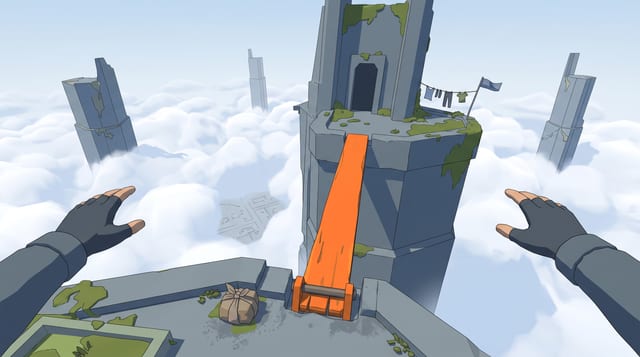
Thin Air Errands
Three hundred metres up, with a storm on the way, you carry your own plank between rooftops, lay it across the gap, and walk it with your arms out.
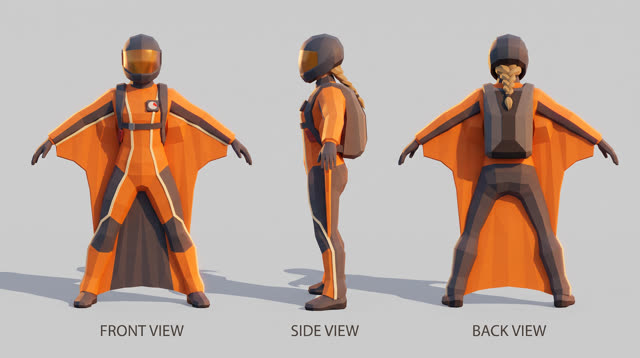
Fjordline
Leap from a granite wall under the midnight sun and carve one unbroken wingsuit line through Norway's most dramatic landscapes, from summit to sea, skimming close enough to touch the rock.
More Unity 6 techniques
Context Steering, Telegraphed Combat & Attack-Token Encounters in Unity 6 →
Readable enemy and companion AI in Unity 6 using 8-ray context steering maps, FOV + line-of-sight hysteresis, telegraph/active/recovery state machines, and an encounter attack-token director.
Seamless Non-Euclidean Portals & Oblique Near-Plane Clipping in Unity 6 URP →
Seamless paired 3D portals in Unity 6 URP 17 using screen-space UV projection, relative camera transform mirroring, exact Camera.CalculateObliqueMatrix near-plane clipping, and software-GPU target scaling.
Frame-Rate-Independent Procedural Springs, Squash-Stretch & Trauma Feel in Unity 6 →
Exact dt-invariant second-order critically/under-damped spring dampers, Squirrel Eiserloh T^2 rotational Perlin camera trauma, volume-preserving squash-and-stretch, and TestClock-safe hit-stop.
Khronos PBR Neutral Tone Mapping & 2D Radiance Cascades GI in Unity 6 URP →
Hue-preserving Khronos PBR Neutral display transform via Unity 6 URP 17.6 RenderGraph (preventing ACES red/blue hue shifts on stylized palettes) paired with a WebGL-2-safe fragment Radiance Cascades 2D GI shader.
Use verified techniques inside a real game
Describe your game idea for free or connect an MCP assistant to search and contribute techniques.