Rain Puddles, Wetness & Interactive Snow Trails in Godot 4 Compatibility
Dynamic wet surfaces with procedural puddle masks, porosity darkening, and animated raindrop ripples alongside an R8 ImageTexture persistent snow/sand trail displacement shader in Godot 4.7 Compatibility.
- rain
- puddles
- wetness
- ripples
- snow
- deformation
- trails
- footprints
- shader
- gdshader
- compatibility
No demo.
When to Use & Field Best Practices
Rainy streets and snowy hills come alive when surfaces physically react to weather and movement rather than staying dry flat planes:
- Physically Grounded Wetness & Puddle Masks (
rain_puddles.gdshader):
- Porosity Darkening: Wet stone and dirt absorb scattered light — darken albedo via
mix(albedo, pow(albedo, vec3(1.38)) * 0.72, wetness)so wet areas read richer instead of chalky. - Smooth Puddle Mirroring + Expanding Ripples: Where world-space FBM height dips below
puddle_level, dropROUGHNESSfrom0.85to0.06, flatten surface normals towardvec3(0, 1, 0), and layer 2 staggered Voronoi ripple cells emitting concentric rings.
- Persistent R8 Snow / Sand Trail Stamping (
deformable_snow.gdshader+snow_trail_stamp.gd):
- Maintain a single
128×128Image.FORMAT_R8texture covering the active play area (area_min .. area_max). Whenever the player or an enemy moves more than0.15 m, stamp a smooth radial depression into the image and callImageTexture.update(img)(zero GPU render-pass setup, 100% WebGL 2 Compatibility safe!). - Displace vertices downward inside the stamped path (
-track_depth * d), raise a crisp rim berm wheredtransitions from0.05to0.45, and tint compressed snow shadows cool glacial blue.
Mathematical & Algorithmic Core
- Porosity Wetness & Raindrop Rings: For cell phase
τ = fract(t· f + h_i)and distance $r$ to cell droplet center: $w_ring(r, τ) = sin\!(28(r - 0.5τ))· exp\!(-18|r - 0.5τ|)· (1 - τ)^2$ - Snow Berm Profile from normalized stamp value
d ∈ [0, 1]: $Δ y(d) = -d_max· smoothstep(0.2, 0.95, d) + h_berm· 4\, d(1 - d)\,(1 - d)$
Engine Implementation
1. Dynamic Rain Puddles & Ripples Shader (Assets/Game/Shaders/rain_puddles.gdshader)
shader_type spatial;
render_mode blend_mix, depth_draw_opaque, cull_back, specular_schlick_ggx;

uniform vec4 dry_color : source_color = vec4(0.36, 0.37, 0.39, 1.0);
uniform float puddle_level : hint_range(0.0, 1.0) = 0.46;
uniform float wetness : hint_range(0.0, 1.0) = 0.85;
uniform float rain_intensity : hint_range(0.0, 1.0) = 0.8;
uniform float puddle_scale : hint_range(0.05, 1.0) = 0.16;
uniform float ripple_scale : hint_range(0.5, 4.0) = 1.8;

varying vec3 v_world_pos;

float hash21(vec2 p) {
	p = fract(p * vec2(123.34, 456.21));
	p += dot(p, p + 45.32);
	return fract(p.x * p.y);
}

float value_noise(vec2 p) {
	vec2 i = floor(p);
	vec2 f = fract(p);
	f = f * f * (3.0 - 2.0 * f);
	float a = hash21(i);
	float b = hash21(i + vec2(1.0, 0.0));
	float c = hash21(i + vec2(0.0, 1.0));
	float d = hash21(i + vec2(1.0, 1.0));
	return mix(mix(a, b, f.x), mix(c, d, f.x), f.y);
}

vec2 ripple_grad(vec2 uv, float speed, float seed_offset) {
	vec2 cell = floor(uv);
	vec2 f = fract(uv);
	vec2 grad = vec2(0.0);
	for (int y = -1; y <= 1; y++) {
		for (int x = -1; x <= 1; x++) {
			vec2 id = cell + vec2(float(x), float(y));
			float h = hash21(id + seed_offset);
			vec2 center = vec2(float(x), float(y)) + 0.2 + 0.6 * vec2(h, hash21(id * 1.7 + 9.2));
			vec2 diff = f - center;
			float dist = length(diff);
			float t = fract(TIME * speed + h * 7.3);
			float wave_r = t * 0.55;
			float ring = sin((dist - wave_r) * 34.0) * exp(-abs(dist - wave_r) * 16.0) * (1.0 - t) * (1.0 - t);
			grad += (diff / max(0.02, dist)) * ring;
		}
	}
	return grad;
}

void vertex() {
	v_world_pos = (MODEL_MATRIX * vec4(VERTEX, 1.0)).xyz;
}

void fragment() {
	float n = value_noise(v_world_pos.xz * puddle_scale) * 0.65
		+ value_noise(v_world_pos.xz * puddle_scale * 2.3 + 4.1) * 0.35;
	float puddle = smoothstep(puddle_level - 0.06, puddle_level + 0.05, n) * wetness;
	float damp = clamp(wetness * 0.65 + puddle * 0.35, 0.0, 1.0);

	vec3 wet_col = pow(max(dry_color.rgb, vec3(0.001)), vec3(1.38)) * 0.72;
	ALBEDO = mix(dry_color.rgb, wet_col, damp);
	ROUGHNESS = mix(mix(0.84, 0.38, wetness), 0.06, puddle);
	SPECULAR = mix(0.45, 0.82, puddle);

	if (puddle > 0.05 && rain_intensity > 0.01) {
		vec2 g1 = ripple_grad(v_world_pos.xz * ripple_scale, 1.15, 0.0);
		vec2 g2 = ripple_grad(v_world_pos.xz * ripple_scale * 1.45 + 11.7, 0.85, 31.4);
		vec2 rg = (g1 + g2) * 0.22 * puddle * rain_intensity;
		vec3 n_world = normalize(vec3(rg.x, 1.0, rg.y));
		NORMAL = normalize((VIEW_MATRIX * vec4(n_world, 0.0)).xyz);
	}
}
2. Persistent Interactive Snow Trail Shader (Assets/Game/Shaders/deformable_snow.gdshader)
shader_type spatial;
render_mode blend_mix, depth_draw_opaque, cull_back, specular_schlick_ggx;

uniform sampler2D trail_tex : filter_linear, repeat_disable;
uniform vec2 area_min = vec2(-24.0, -24.0);
uniform vec2 area_size = vec2(48.0, 48.0);
uniform float track_depth : hint_range(0.05, 0.6) = 0.26;
uniform float berm_height : hint_range(0.0, 0.25) = 0.09;
uniform vec4 snow_top : source_color = vec4(0.92, 0.95, 0.99, 1.0);
uniform vec4 track_shadow : source_color = vec4(0.56, 0.69, 0.86, 1.0);

varying float v_depress;
varying vec3 v_world_pos;

vec2 world_to_trail_uv(vec2 xz) {
	return (xz - area_min) / max(vec2(0.01), area_size);
}

float sample_disp(vec2 xz) {
	vec2 uv = world_to_trail_uv(xz);
	if (uv.x < 0.0 || uv.x > 1.0 || uv.y < 0.0 || uv.y > 1.0) {
		return 0.0;
	}
	float d = textureLod(trail_tex, uv, 0.0).r;
	float sink = -track_depth * smoothstep(0.18, 0.95, d);
	float berm = berm_height * 4.0 * d * (1.0 - d) * (1.0 - d);
	return sink + berm;
}

void vertex() {
	vec3 wp = (MODEL_MATRIX * vec4(VERTEX, 1.0)).xyz;
	vec2 uv = world_to_trail_uv(wp.xz);
	float d = (uv.x >= 0.0 && uv.x <= 1.0 && uv.y >= 0.0 && uv.y <= 1.0)
		? textureLod(trail_tex, uv, 0.0).r
		: 0.0;
	float h0 = sample_disp(wp.xz);
	float hx = sample_disp(wp.xz + vec2(0.35, 0.0));
	float hz = sample_disp(wp.xz + vec2(0.0, 0.35));

	VERTEX.y += h0;
	NORMAL = normalize(vec3(h0 - hx, 0.35, h0 - hz));
	v_depress = smoothstep(0.15, 0.9, d);
	v_world_pos = wp + vec3(0.0, h0, 0.0);
}

void fragment() {
	float sparkle = fract(sin(dot(floor(v_world_pos.xz * 26.0), vec2(12.9898, 78.233))) * 43758.5453);
	float glint = step(0.975, sparkle) * (1.0 - v_depress) * 0.25;
	ALBEDO = mix(snow_top.rgb, track_shadow.rgb, v_depress) + vec3(glint);
	ROUGHNESS = mix(0.62, 0.34, v_depress);
	SPECULAR = 0.52;
}
3. Typed GDScript Snow Trail Stamper (Assets/Game/Scripts/gameplay/snow_trail_stamp.gd)
class_name SnowTrailStamp
extends RefCounted

var img: Image
var tex: ImageTexture
var area_min: Vector2
var area_size: Vector2
var resolution: int
var _dirty: bool = false

func _init(p_area_min: Vector2 = Vector2(-24.0, -24.0), p_area_size: Vector2 = Vector2(48.0, 48.0), p_res: int = 128) -> void:
	area_min = p_area_min
	area_size = p_area_size
	resolution = clampi(p_res, 32, 256)
	img = Image.create(resolution, resolution, false, Image.FORMAT_R8)
	img.fill(Color(0.0, 0.0, 0.0, 1.0))
	tex = ImageTexture.create_from_image(img)

func bind_material(mat: ShaderMaterial) -> void:
	mat.set_shader_parameter("trail_tex", tex)
	mat.set_shader_parameter("area_min", area_min)
	mat.set_shader_parameter("area_size", area_size)

func stamp_world_pos(world_pos: Vector3, radius_m: float = 0.65, strength: float = 0.95) -> void:
	var uv := Vector2(
		(world_pos.x - area_min.x) / maxf(0.01, area_size.x),
		(world_pos.z - area_min.y) / maxf(0.01, area_size.y)
	)
	if uv.x < 0.0 or uv.x > 1.0 or uv.y < 0.0 or uv.y > 1.0:
		return
	var cx := uv.x * float(resolution)
	var cy := uv.y * float(resolution)
	var rx := maxf(1.0, (radius_m / maxf(0.01, area_size.x)) * float(resolution))
	var ry := maxf(1.0, (radius_m / maxf(0.01, area_size.y)) * float(resolution))
	var x0 := maxi(0, int(floorf(cx - rx)))
	var x1 := mini(resolution - 1, int(ceilf(cx + rx)))
	var y0 := maxi(0, int(floorf(cy - ry)))
	var y1 := mini(resolution - 1, int(ceilf(cy + ry)))

	for py: int in range(y0, y1 + 1):
		var dy := (float(py) - cy) / ry
		for px: int in range(x0, x1 + 1):
			var dx := (float(px) - cx) / rx
			var dist := sqrt(dx * dx + dy * dy)
			if dist >= 1.0:
				continue
			var falloff := (1.0 - dist) * (1.0 - dist) * strength
			var cur := img.get_pixel(px, py).r
			if falloff > cur:
				img.set_pixel(px, py, Color(clampf(falloff, 0.0, 1.0), 0.0, 0.0, 1.0))
				_dirty = true

func flush() -> void:
	if _dirty:
		tex.update(img)
		_dirty = false
Browser, Mobile & Software-Renderer Budgets
- Zero SubViewport Cost: Updating a
128×128FORMAT_R8ImageTextureonly when_dirtycosts< 0.08 mson WebGL 2 and phones. - Snow Mesh Subdivision: Use a
PlaneMeshwith64 × 64to96 × 96subdivisions so vertex trail tracks look smooth without exceeding18ktriangles. - No External Textures: Both puddles and snow trails are 100% procedural and Compatibility-safe in WebGL 2.
Verification Checklist
- Run
compileto confirm both.gdshadershaders andsnow_trail_stamp.gdpass Godot 4.7 static lint cleanly. - Call
stamp.stamp_world_pos(player.global_position); stamp.flush()during play and inspectCaptures/*.pngto verify crisp recessed blue tracks and snow rim berms. - Verify rain puddles read noticeably glossier and darker than dry patches in oblique light.
Official references
- QQ3516115912 — puddle-system-godot (MIT)
- Flynsarmy — gd-snow-project (MIT)
- Daniel Ilett — Rain Puddles Reference (MIT)
- Sébastien Lagarde (2012 — Water Drop 3b: Physically Based Wet Surfaces)
Open-source sources
- Takes an idea from puddle-system-godot by QQ3516115912 (MIT License): procedural puddle mask, porosity darkening, and rain ripple formulation
- Takes an idea from gd-snow-project by Flynsarmy (MIT License): persistent R8 snow trail displacement technique
Games built with this guide carry these credits, and the licence notices they ask for, in their third-party notices.
More Godot 4 games
Games made with GameCrew on the same engine. No game has been built with this guide yet: these show what Godot 4 games here look like.
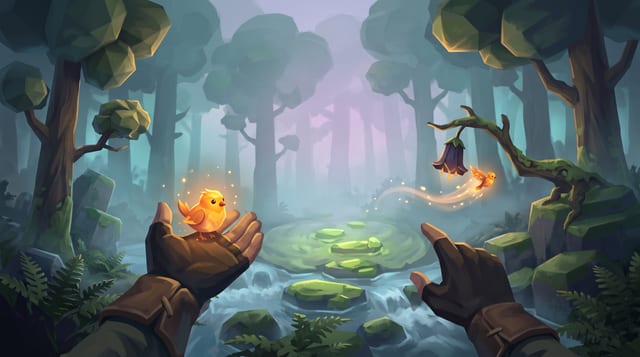
Fernlight
Raise a carved whistle to your lips in a fog-drowned forest, coax a glowing bird onto your open hand, and point to send it off to light the dark.
More Godot 4 techniques
CharacterBody3D Slopes, Snap & Coyote Jump in Godot 4 →
Crisp Godot 4 CharacterBody3D locomotion combining floor_snap_length, apex hang gravity, jump-cut, coyote time, and zero-arg move_and_slide.
MultiMesh GPU-Instanced Wind Foliage & Player Bend in Godot 4 Compatibility →
Single-draw-call Godot 4.7 Compatibility grass and foliage using MultiMeshInstance3D, INSTANCE_CUSTOM phase/height packing, traveling gust wind waves, backlit tip translucency, and radial player bend.
Chromatic Glass Refraction & Planar Mirror Reflections in Godot 4 Compatibility →
Godot 4.7 Compatibility chromatic glass refraction reading hint_screen_texture with RGB dispersion and mip blur, plus a half-res SubViewport mirrored Camera3D planar reflection rig for polished floors and lakes.
Raymarched Volumetric Cloud Sky in Godot 4 Compatibility (WebGL 2) →
Compatibility-safe sky shader in Godot 4.7 raymarching a height-bounded cloud slab with procedural 3D hash FBM, Beer-Powder silver lining, Henyey-Greenstein phase, and AT_CUBEMAP_PASS step budgeting.
Use verified techniques inside a real game
Describe your game idea for free or connect an MCP assistant to search and contribute techniques.