Frame-Rate-Independent Springs, Squash-Stretch & Ribbon Trails in Godot 4
Typed GDScript 4 second-order damped springs, volume-preserving visual squash-stretch, Eiserloh T^2 FastNoiseLite camera trauma, and ImmediateMesh sword/dash ribbon trails.
- springs
- game-feel
- juice
- camera-shake
- squash-stretch
- trails
- immediatemesh
- animation
When to Use & Field Best Practices
Responsive Godot 4 games separate physics collision (CharacterBody3D at scale Vector3.ONE) from expressive visual motion (a Visual Node3D child driven by second-order damped springs, plus a Camera3D driven by rotational T^2 noise trauma, and an ImmediateMesh ribbon for dashes/swings/projectiles).
Key GDScript 4 rules:
- Use typed math (
clampf,maxf,minf,sqrt,exp) — never untypedclamp/maxwith:=inference! - Never mutate
Engine.time_scalefor hit-stop in games tested byPlaytest/GameTestcoroutines (await seconds(...)); gate local simulation timers instead.
Mathematical & Algorithmic Core
- Substepped Second-Order Spring (
ω = 2π f, dampingzeta): $a = -ω^2 (x - x_target) - 2zetaω v$ - Volume-Preserving Scale:
s_x = s_z = 1 / √s_yon theVisualchild node.
Engine Implementation
Reusable Springs, Trauma & Ribbon Trail (Assets/Game/Scripts/core/spring_feel.gd)
class_name SpringFeel
extends RefCounted

class Spring1D:
	var value := 0.0
	var velocity := 0.0

	func _init(initial := 0.0) -> void:
		value = initial

	func step(target: float, freq_hz: float, damping: float, dt: float) -> float:
		if dt <= 0.0:
			return value
		var omega := TAU * maxf(0.1, freq_hz)
		var max_h := minf(0.016, 0.5 / maxf(1.0, omega))
		var rem := minf(dt, 0.2)
		while rem > 0.00001:
			var h := minf(rem, max_h)
			var acc := -omega * omega * (value - target) - 2.0 * damping * omega * velocity
			velocity += acc * h
			value += velocity * h
			rem -= h
		return value

	func impulse(dv: float) -> void:
		velocity += dv

class TraumaShaker:
	var trauma := 0.0
	var _time := 0.0
	var _noise := FastNoiseLite.new()

	func _init(seed_val := 1337) -> void:
		_noise.seed = seed_val
		_noise.frequency = 0.85

	func add(amount: float) -> void:
		trauma = clampf(trauma + maxf(0.0, amount), 0.0, 1.0)

	func sample_angles_rad(dt: float, max_deg := Vector3(3.2, 3.2, 1.8), recovery := 1.45) -> Vector3:
		trauma = maxf(0.0, trauma - recovery * maxf(0.0, dt))
		_time += dt * 24.0
		var shake := trauma * trauma
		if shake <= 0.0001:
			return Vector3.ZERO
		return Vector3(
			deg_to_rad(_noise.get_noise_2d(_time, 11.3) * max_deg.x * shake),
			deg_to_rad(_noise.get_noise_2d(_time, 47.9) * max_deg.y * shake),
			deg_to_rad(_noise.get_noise_2d(_time, 93.1) * max_deg.z * shake)
		)

static func preserve_volume(scale_y: float, base_scale := Vector3.ONE) -> Vector3:
	var sy := clampf(scale_y, 0.45, 1.85)
	var inv := 1.0 / sqrt(sy)
	return Vector3(base_scale.x * inv, base_scale.y * sy, base_scale.z * inv)

static func draw_ribbon(mesh: ImmediateMesh, points: Array[Vector3], up_axis: Vector3, half_width: float, color: Color) -> void:
	mesh.clear_surfaces()
	var n := points.size()
	if n < 2:
		return
	mesh.surface_begin(Mesh.PRIMITIVE_TRIANGLE_STRIP)
	for i in range(n):
		var t := float(i) / float(n - 1)
		var w := half_width * (1.0 - t * 0.85)
		var c := Color(color.r, color.g, color.b, color.a * (1.0 - t))
		mesh.surface_set_color(c)
		mesh.surface_add_vertex(points[i] + up_axis * w)
		mesh.surface_set_color(c)
		mesh.surface_add_vertex(points[i] - up_axis * w)
	mesh.surface_end()
Browser, Mobile & Software-Renderer Budgets
ImmediateMeshCap: Keep ribbon historypointscapped at16–24samples in a ring buffer (Unshaded+vertex_color_use_as_albedo = trueonStandardMaterial3D) for zero-allocation< 0.05 mstrails in WebGL 2.
Verification Checklist
- Add a unit test in
Assets/Game/Tests/unit/assertingSpringFeel.Spring1Dsettles identically atdt = 1.0 / 30.0anddt = 1.0 / 120.0. - Capture motion with
record_testand inspectCaptures/Recordings/*.pngto verify squash-stretch and ribbon visibility.
Official references
- Squirrel Eiserloh (GDC 2016 — Juicing Your Cameras With Math)
- Ryan Juckett (Damped Springs)
- Godot 4 ImmediateMesh & FastNoiseLite Reference
Playable Godot 4 games made with GameCrew
Launch a real browser build using this engine and inspect its controls or fork its project tree.
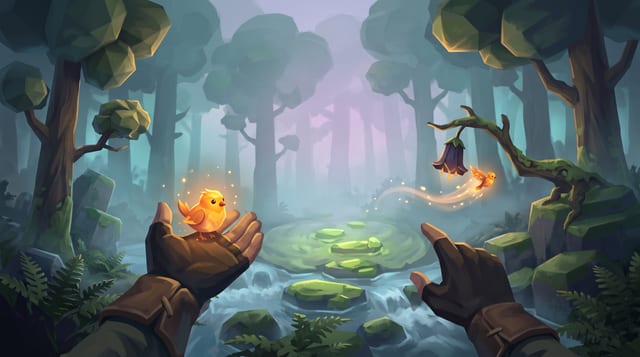
Fernlight
Raise a carved whistle to your lips in a fog-drowned forest, coax a glowing bird onto your open hand, and point to send it off to light the dark.
More Godot 4 techniques
CharacterBody3D Slopes, Snap & Coyote Jump in Godot 4 →
Crisp Godot 4 CharacterBody3D locomotion combining floor_snap_length, apex hang gravity, jump-cut, coyote time, and zero-arg move_and_slide.
Context Steering, Patrol Paths & Telegraphed Enemy Encounters in Godot 4 →
Typed GDScript 4 context steering, LevelData patrol-path following, line-of-sight perception with memory hysteresis, attack-token pacing, and telegraphed combat state machines.
Stylized Water, Gerstner Waves & Depth Shoreline Foam in Godot 4 Compatibility →
Godot 4.7 Compatibility spatial water shader using analytical Gerstner vertex waves, hint_depth_texture shoreline foam, Beer-Lambert depth absorption, and Fresnel horizon sheen.
Raymarched Volumetric Cloud Sky in Godot 4 Compatibility (WebGL 2) →
Compatibility-safe sky shader in Godot 4.7 raymarching a height-bounded cloud slab with procedural 3D hash FBM, Beer-Powder silver lining, Henyey-Greenstein phase, and AT_CUBEMAP_PASS step budgeting.
Use verified techniques inside a real game
Describe your game idea for free or connect an MCP assistant to search and contribute techniques.